Can Google Rank a Website Built Entirely UsingAI? Practical insights
Yes, Google can rank a website built entirely using AI. Google does not automatically penalise websites for using AI-generated content, layouts or code. Instead, it evaluates whether the pages provide helpful, original, accurate and reliable information that satisfies users’ search intent.
However, building a website with AI and ranking it on Google are two different things. AI website builders can simplify website creation, but technical SEO, content quality, user experience and website authority still influence search visibility.
This article tests that belief, then explains what Google checks and what you need to add after the tool finishes its work. The best no-code website builder gives you a fast start, but your search visibility depends on the steps that follow.
Google Ranks Pages, Not Production Methods
The belief is mostly wrong. Google says in its published guidance that it rewards beneficial content no matter how someone produced it. In other words, automation is fine when the content serves the reader. A human can write a poor page, and AI can help draft a strong one because Google looks at how useful, accurate, and trustworthy the page is.
The risk lies in publishing too many weak pages. Google calls this scaled content abuse. This happens when a site creates many pages that mainly exist to attract search traffic and don’t provide much value to visitors. An AI builder does not cause this on its own. The problem starts when you publish dozens of similar pages without checking them. So how does Google decide which pages deserve to appear?
Source – Google’s guidance on AI-generated content
Research: Can fully AI-generated content rank on Google?
A July 2026 Ahrefs study found that 5.3% of sampled pages ranking in Google’s top three positions were classified as entirely AI-generated. However, content with lower estimated AI usage was considerably more common.
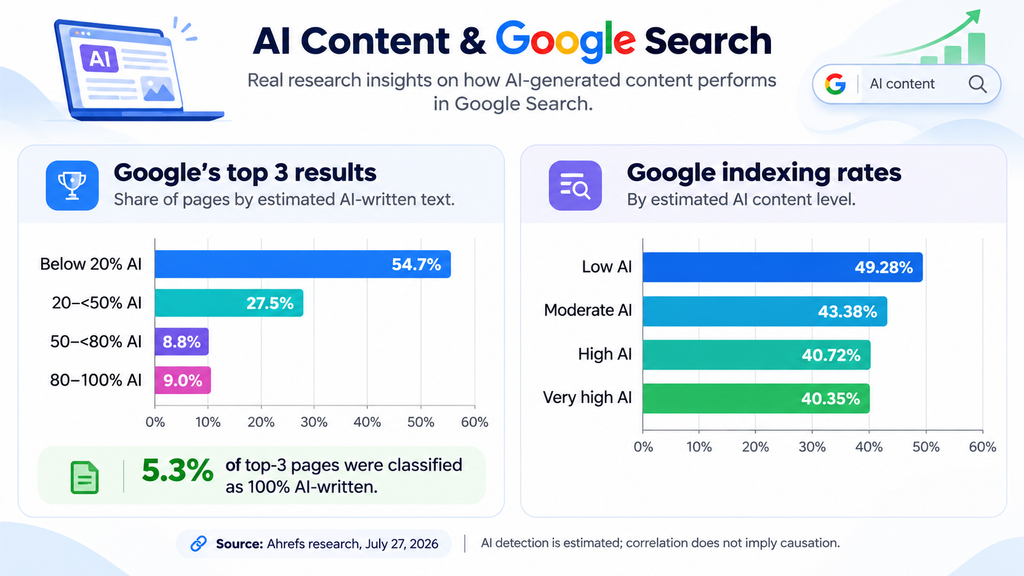
Source: Ahrefs, July 27, 2026. Based on estimated AI-written text, not entire website construction methods.
Three Checkpoints Every AI-Built Website Must Pass
Google processes website content in three main stages: crawling, indexing and serving search results.
Can Google find the site?
Google cannot rank a page that it has not found and indexed, and many AI-built sites never get past this first step. The reasons are usually simple. Some owners share the builder’s preview link instead of the live website address, so Google never reaches the real site. Others skip the sitemap, while in some cases, a builder setting tells search engines to stay away from the site. A slow site or heavy scripts can also make it harder for Google to read the pages.
The right tool makes this step easier. The best AI website builder for beginners builds a clean structure for your page, allows you to change the description and title, and automatically builds a sitemap. Make sure your live site loads quickly on a phone and that search visibility is enabled in the builder settings before you publish. Then add the site to Google Search Console and submit the sitemap. Google will determine which pages to keep based on its ability to access them.
Does the Content Provide Enough Value to Be Indexed?
Google does not index every page it discovers. It checks whether a page offers useful information and deserves a place in its search index. AI tools rely on common patterns, so their default copy often looks like text on thousands of other sites. A page that repeats general advice gives Google little reason to include it.
Original details solve this problem. You can describe your process, name your service area, explain how you price your work, or share advice that comes from doing the job. Each detail gives your page its identity. Google’s quality guidelines call this experience, expertise, authoritativeness and trust (E-E-A-T), a set of qualities that describe helpful, reliable content. Once a page earns a place in the index, it competes with other pages for position.
Is the Page Relevant to What People Search For?
At this stage, Google compares your page with others that answer the same search. It also checks how well your page matches what the visitor wants. For instance, someone searching for a local accountant expects a phone number, a list of services and proof of credentials. A long essay on tax history will not meet that need.
Additional signals can influence search visibility too. Relevant links from other websites can help Google understand how important your pages are. For local businesses, accurate business information and genuine customer reviews can also support local search visibility. These signals develop over time.
The Human Layer: What AI Cannot Supply
An AI tool can generate content quickly, but it cannot verify the actual details of your business. You need to review its output and add information from your real operations. These four additions make the most significant difference:
- Business details: your address, team members, service process and pricing approach.
- Original information: photographs of your real work, customer examples and short case descriptions.
- Fact checks: verify every claim, date and figure the tool generates.
- Distinct pages: each page should have its own purpose and wording, since two service pages with the same paragraphs compete with each other.
After you finish these edits, read each page aloud. Any section that sounds generic usually needs a concrete example from your business. Then you’re ready to publish and start tracking results.
Your First 30 Days After Launch
After launch, a few basic checks show how Google is processing your website.
30-Day SEO Roadmap for AI Websites
From website launch to search visibility.
-
Days 1–7
Technical Setup
In week one, verify your domain in Google Search Console and submit your sitemap. Use the URL Inspection tool to see if Google can reach your homepage and key service pages.
-
Days 8–14
Indexing & Content Audit
Check the page indexing report in the second week. Find out what’s causing the problem and get key pages indexed. You might need to resolve technical difficulties, improve internal links, or verify for duplicate content.
-
Days 15–21
On-Page Optimisation
Improve titles, descriptions, page content, images and mobile performance.
-
Days 22–30
Monitor & Improve
Review the performance report to see if you’re getting impressions and clicks on your site. Examine the search queries people are using to locate your site and see if your titles and descriptions are relevant to the subject of each page.
SEO is an ongoing process. Indexing and search rankings are not guaranteed within 30 days.
Have patience. A new website can take weeks or months to establish search visibility. Google doesn’t promise immediate indexing or ranking, so give your site time to be found and evaluated.
FAQs
Final Thoughts
In short, Google can rank a website built entirely with AI, and its guidance supports this assertion. The tool writes the first draft, and you decide whether the site is easy to find, original and trustworthy.
Before you publish any page, apply one test: does it tell visitors something useful that a template site cannot? Pages that pass give Google a reason to index and rank them. A reliable builder shortens the work, and your knowledge of the business earns the position.