How to Verify Blogger website in Search Console? ( Visual Guide )
Want to connect your Blogger website to Google Search Console?
Google Search Console is a free tool that helps you understand how your Blogger site appears in Google Search. You can use it to check indexing issues, see which search queries bring visitors to your blog, monitor clicks and impressions, submit sitemaps, and inspect individual URLs.
The good news is that Blogger websites can often be verified automatically when you use the same Google account for Blogger and Google Search Console. If automatic verification doesn’t work, you can verify your blog manually using an HTML meta tag.
What Is Google Search Console?
Google Search Console, commonly called GSC, is a free service from Google that helps website owners monitor their site’s presence in Google Search.
After connecting your Blogger blog to Search Console, you can use it to:
- Check whether your posts are indexed by Google
- Find crawling and indexing problems
- See your Google Search clicks and impressions
- Discover which keywords or search queries bring traffic
- Inspect individual blog posts
- Submit and monitor your sitemap
- Check mobile and search-related issues
- Receive alerts about certain problems affecting your site
Google Search Console doesn’t directly improve your rankings simply because you connect your site to it. Instead, it gives you data and diagnostic tools that can help you discover and fix SEO problems.
Quick Steps to Add Blogger to Google Search Console
In this guide, I’ll show you both methods step by step.
1. Sign in to your Google Account and go to the Search Console homepage
(https://search.google.com/search-console).
2. Click on the “Add a Property” button.
3. Here We will choose the URL Prefix option, enter the URL of your Blogger website. Make sure to include the “http://” or “https://” prefix.
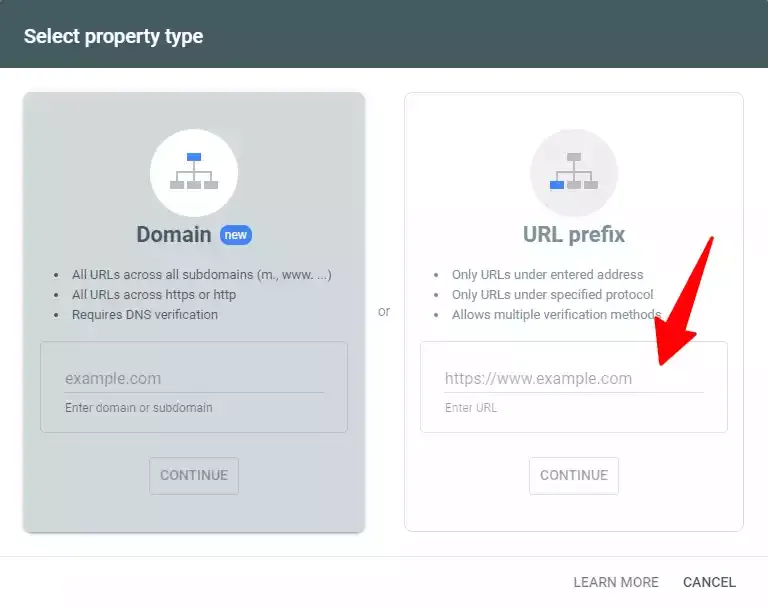
4. Click the “Continue” button.
5. On the next page, you will be presented with several options for verifying your website. Choose the “HTML Tag” option.
6. Copy the HTML tag provided.

7. Sign in to your Blogger account and go to the “Theme” section for your website.
8. Click on the “Edit HTML” option from the drop-down menu.
9. Now you need to paste that HTML tag just below the head tag (<head> or <head> )
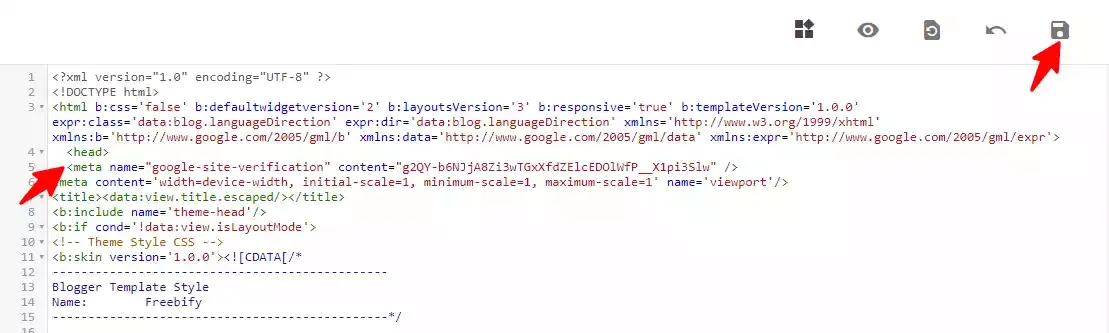
10. Click the “Save Changes” button.
11. Return to Search Console and click the “Verify” button.
If the verification is successful, you will see a message indicating that your website has been verified.
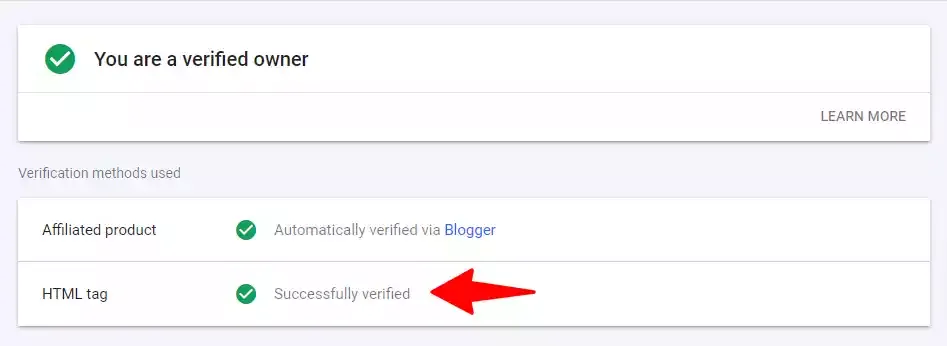
If the verification is not successful, you may need to troubleshoot the issue. Some common issues include using the wrong URL, using an unsupported verification method, or not saving your changes in Blogger.
Once your website is verified in Search Console, you can start using the tools and features available to track and improve your website’s performance in Google search results.
Important: Don’t Remove the Verification Tag
If you verified your site using an HTML tag, leave the verification tag in your Blogger theme.
Search Console can periodically check whether the verification token is still present. Removing it may eventually affect ownership verification.
Also remember that installing or replacing your Blogger theme may remove the verification tag. If you change your theme later, check that the tag is still present.
URL Prefix vs Domain Property: Which Should Blogger Users Choose?
Google Search Console offers two main types of properties.
URL Prefix Property
A URL-prefix property covers only the URL version you enter.
For example: https://www.example.com
URL-prefix properties support several verification methods, including HTML tags, Google Analytics and Google Tag Manager.
For most blogspot.com Blogger websites, URL prefix is the easiest option.
Domain Property
A Domain property can include multiple protocols and subdomains under one domain.
For example, a property for: example.com can include versions such as: https://example.com / https://www.example.com and other subdomains.
Domain-property verification requires adding a DNS record through your domain provider.
Therefore, this method is mainly useful if your Blogger website uses a custom domain and you have access to its DNS settings.
Verify Domain Property in Search console
Learn How to Verify Domain Property in Google search console by following this video.

How to Submit a Blogger Sitemap to Google Search Console
After verifying your Blogger website, you can also submit your sitemap.
Blogger normally provides a sitemap automatically.
Open your Search Console property and go to:
Indexing → Sitemaps
Under Add a new sitemap, enter: sitemap.xml
Then click Submit.
For example, your sitemap may look like: https://example.blogspot.com/sitemap.xml or: https://www.example.com/sitemap.xml
Submitting a sitemap helps Google discover URLs on your website, particularly for newer or larger websites. However, submitting a sitemap is a hint to Google and does not guarantee that every URL will be crawled, indexed, or ranked.
How to Check Whether a Blogger Post Is Indexed
Once Search Console is configured, you can inspect individual Blogger posts.
Open the URL Inspection tool and paste the complete URL of a blog post.
Search Console will tell you whether Google currently knows about the URL and provide information about its indexing status.
If you’ve recently published or significantly updated a page, you can use Request indexing.
Keep in mind that requesting indexing doesn’t guarantee immediate indexing. Google states that crawling may take anywhere from several days to several weeks, and repeatedly requesting indexing for the same URL won’t make it happen faster.
Conclusion
To conclude, verifying your Blogger website in Google Search Console is a straightforward process that will allow you to monitor and improve your website’s performance in Google search results.
By following the steps outlined above, you can easily add your Blogger website to Search Console and start using the tools and features available to track and optimize your website.
Verifying your website in Search Console is an important step in ensuring that your website is visible and easily found by users in search results, and is therefore an essential part of any online marketing strategy.
FAQs
Here are some frequently asked questions about verifying a Blogger website in Google Search Console:


![What is Backlink with Example [Infographics]](https://www.techyleaf.in/wp-content/uploads/2022/06/What-is-Backlink-768x432.jpg)